
Google's Modern Algorithms: 5 Important Updates Every SEO Beginner Should Know
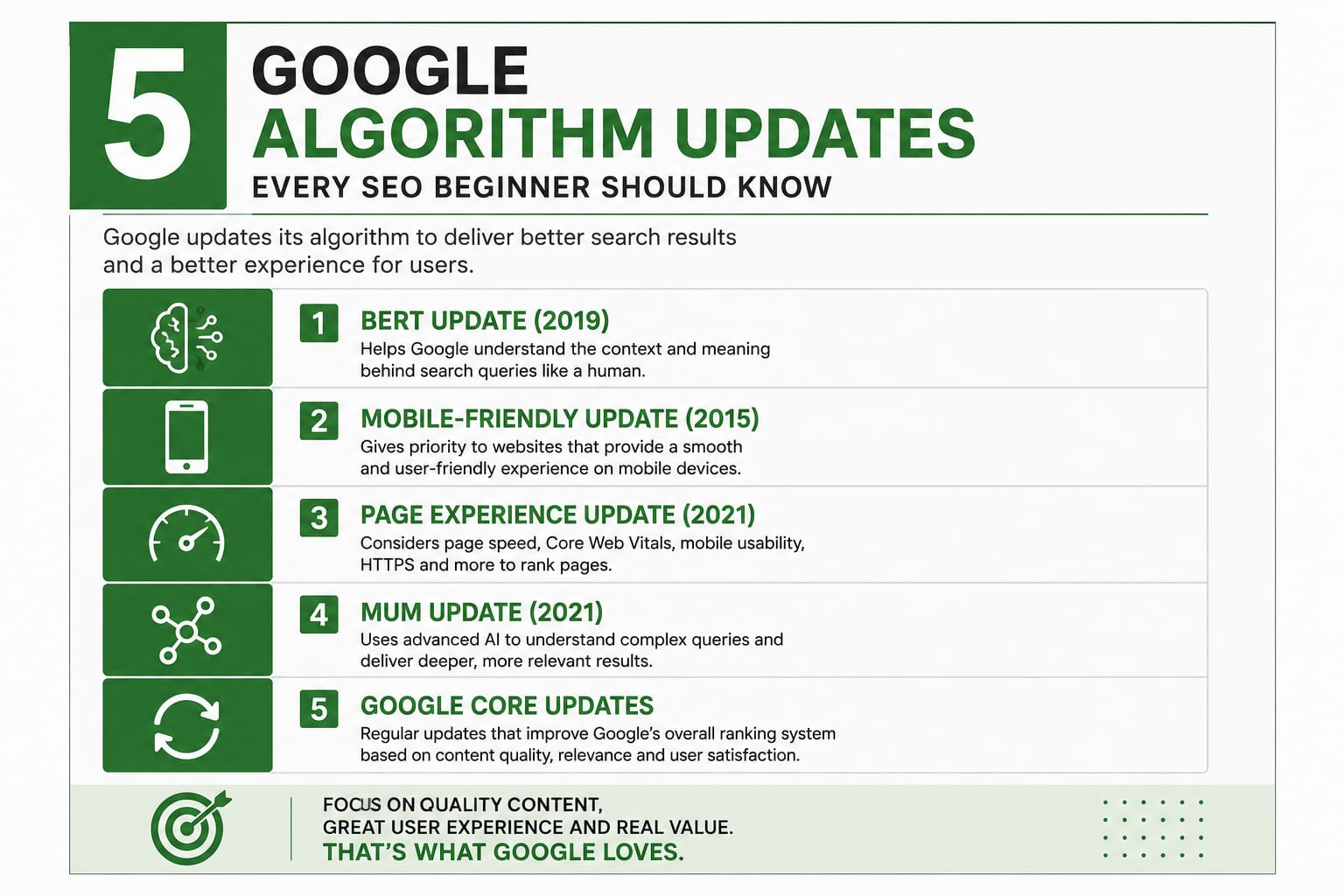
Google Algorithms play a major role in determining which websites appear in search results and how they are ranked. Understanding these algorithms is important for anyone who wants to improve their website’s visibility through SEO. If you’ve ever searched for something on Google, you’ve probably noticed that the most useful websites usually appear at the top of the search results. This isn’t random—it’s the result of Google’s powerful search algorithm.
As a digital marketer or SEO beginner, understanding how Google’s algorithm works is essential. Every major algorithm update changes how websites are ranked and encourages website owners to focus on creating better user experiences rather than manipulating search rankings.
In this blog, we will first understand what Google’s algorithm is and then explore five important modern algorithm updates that have transformed the way search engines rank websites. Whether you’re a student, website owner, content creator, or simply curious about SEO, this guide will help you understand these updates in a simple and easy-to-follow way.
How Do Google Algorithms Work?
Google’s algorithm is a collection of systems and rules that decide which web pages should appear in search results. Whenever someone types a query into Google, the search engine scans billions of web pages in just a fraction of a second and ranks the most relevant and helpful ones.
Google doesn’t rank websites based on a single factor. Instead, it considers hundreds of ranking signals, such as
– Content quality
– Keyword relevance
– Website speed
– Mobile friendliness
– User experience
– Backlinks
– Website security
– Search intent
Google updates its algorithm thousands of times every year. While most updates are small, some major ones significantly change how SEO works.
Let’s look at five of the most important modern Google algorithm updates.
—
1. BERT Update (2019)
One of Google’s biggest AI improvements was the BERT (Bidirectional Encoder Representations from Transformers) update.
Before BERT, Google mainly looked at individual keywords in a search query. After BERT, Google became much better at understanding the meaning of an entire sentence.
For example, if someone searches:
“Can I get medicine for someone at a pharmacy?”
Google now understands the context of the sentence instead of simply matching individual words.
Why BERT Matters
– Understands the meaning behind complete sentences instead of focusing only on individual words.
– Delivers search results that better match what users are actually looking for.
– Improves Google’s ability to understand natural conversations.
– Makes search results more relevant and accurate.
SEO Tip
Create content that sounds natural and answers users’ questions clearly instead of writing only for search engines.
2. Mobile-Friendly Update (2015)
As more people started browsing the internet on smartphones, Google introduced the Mobile-Friendly Update, often called Mobilegeddon.
This update rewards websites that provide a good experience on mobile devices.
Today, most Google searches happen on mobile phones, making mobile optimization more important than ever.
Google Checks
– Responsive website design
– Easy-to-read text
– Proper button sizes
– Fast mobile loading
– Mobile usability
SEO Tip
Always design your website with mobile users in mind before optimizing for desktop.
—
3. Page Experience Update (2021)
Google wants users to enjoy browsing websites, not just find information.
That’s why it introduced the Page Experience Update.
This update measures how comfortable and smooth a website feels for visitors.
Some important ranking signals include:
– Fast loading speed
– Core Web Vitals
– HTTPS security
– Mobile friendliness
– No annoying pop-ups
If two websites have similar content, the one offering a better user experience may rank higher.
SEO Tip
Improve your website’s speed and make navigation simple and user-friendly.
—
4. MUM Update (2021)
The MUM (Multitask Unified Model) update is one of Google’s most advanced AI technologies.
It helps Google understand complex questions and even connect information from different languages and content formats like text and images.
Imagine a student searching:
“What’s the easiest way to learn SEO from scratch?”
Google’s MUM algorithm understands the learner’s goal and can display beginner-friendly guides, tutorials, videos, and other useful learning resources instead of relying only on exact keyword matches.
Why MUM Matters
– Understands difficult questions.
– Supports multilingual searches.
– Connects information from multiple sources.
– Improves search quality using AI.
SEO Tip
Create complete, detailed content that answers users’ questions instead of focusing on a single keyword.
—
5. Google Core Updates
Unlike specific algorithm updates, Core Updates happen several times a year.
These updates improve Google’s overall ranking system.
A core update doesn’t usually target one specific issue. Instead, Google reassesses how it evaluates content quality, relevance, trustworthiness, and user satisfaction.
Sometimes websites gain rankings after a core update, while others lose positions.
This doesn’t necessarily mean the lower-ranked websites did something wrong. It simply means Google found other pages that better satisfy user intent.
Google Rewards
– Helpful content
– Expertise
– Trustworthy information
– Better user experience
– Updated content
SEO Tip
Focus on consistently publishing high-quality content rather than chasing algorithm changes.
—
Why Should SEO Beginners Learn About Google Algorithms?
Google algorithms help create a better internet experience.
They encourage website owners to:
– Publish original content.
– Improve website speed.
– Build trust.
– Focus on users.
– Avoid spammy SEO techniques.
– Keep websites updated.
If you understand these updates, you’ll know why Google rewards some websites while others struggle to rank.
—
Best Practices for Long-Term SEO Success
Instead of worrying about every algorithm update, follow these simple SEO habits:
– Write useful and original content.
– Understand user search intent.
– Optimize your website for mobile devices.
– Improve page loading speed.
– Build natural backlinks.
– Update old content regularly.
– Avoid keyword stuffing.
– Create a great user experience.
– Focus on solving users’ problems.
Google’s algorithms may change, but these practices continue to deliver strong results over time.
—
Conclusion
Google’s algorithms are constantly evolving to provide users with the most accurate and helpful search results.
These algorithm updates clearly show how Google Search has evolved over the years. Today, ranking a website depends on much more than simply using the right keywords. Content quality, user satisfaction, and website performance all play an important role.
If you’re just starting your SEO journey, focus on understanding your audience rather than chasing every algorithm change. Websites that consistently provide useful information are more likely to earn long-term visibility. The best approach is to publish content that answers real questions, solves problems, and provides value to readers. As your content becomes more useful and trustworthy, your chances of achieving better search visibility naturally increase.
Building strong SEO results takes patience and continuous improvement. By regularly publishing valuable content and maintaining a positive user experience, you can gradually improve your website’s performance in Google Search.